
Mikati condemns Israeli aggression in South Lebanon, calls for international intervention

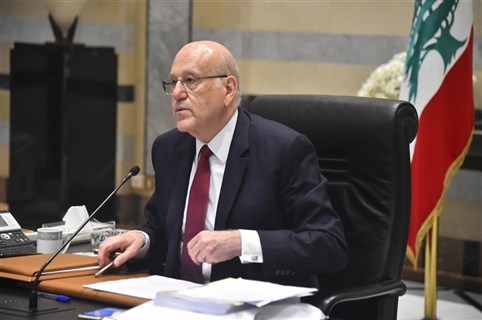
NNA – Caretaker Prime Minister, Najib Mikati, on Friday began the cabinet session with a strong condemnation of ongoing Israeli attacks on South Lebanon. He emphasized that these deliberate killings, destruction of towns, and burning of crops are not only condemnable, but also constitute a destructive and terrorist aggression that the international community must halt. Mikati reiterated Lebanon's commitment to fully implementing UN Resolution 1701.

The PM then expressed gratitude to friendly nations for their efforts to halt Israeli aggression and welcomed UN Security Council Resolution 2732, which outlines a roadmap to cease the fighting in Gaza. He urged for its swift implementation to prevent a broader regional conflict.

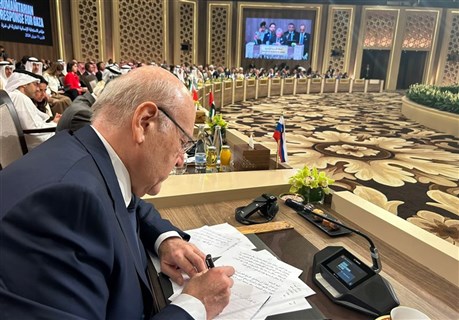
This week, Mikati attended the "Emergency Humanitarian Response in Gaza" conference in Jordan, where Lebanon's presence and stance were reinforced. He emphasized the need for continued support for Lebanon and pressure on Israel. The conference laid the groundwork for another event to launch a support campaign for Gaza and affected areas.

Mikati further highlighted the prolonged vacancy in Lebanon's presidency, urging all parties to engage in dialogue to elect a new president and restore stability to the country's institutions. He welcomed and appreciated all initiatives towards this goal.

The Prime Minister also acknowledged the Internal Security Forces on their anniversary, thanking the UAE for its support and commending Qatar for its continuous efforts to enhance the capabilities of the Lebanese Army.

He celebrated the recognition of the Lebanese University by QS Rankings for 2025 as the top institution in Lebanon for its professional and academic reputation.

Mikati went on to address the proposal from the Ministry of Economy and Trade regarding Qatar Electricity's offer. He detailed the steps taken to negotiate the development of 100 MW of solar power in two locations, highlighting the need for legal and contractual clarity. He noted that TotalEnergies had withdrawn from acquiring existing licenses and emphasized the necessity of a legal framework for a 25-year Power Purchase Agreement.

Looking ahead to the summer tourism season, Mikati praised the efforts of the Minister of Tourism and expressed hope for a successful season that would bolster Lebanon's status on the global tourism map, welcoming both Lebanese expatriates and Arab visitors.

Mikati concluded by reaffirming his respect for the judiciary amid recent political debates, clarifying the government's position on legal matters related to old rent laws and teachers. He extended his best wishes to all the Lebanese for a peaceful and blessed Eid al-Adha.

Mikati at “Urgent Humanitarian Response for Gaza” conference in Jordan: Our south and its people are in a real catastrophe

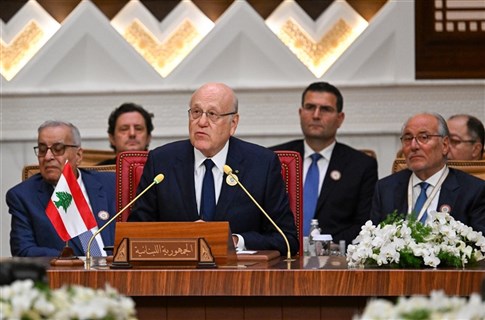
NNA - Caretaker Prime Minister, Najib Mikati, on Tuesday delivered a word at the  ‘Urgent Humanitarian Response for Gaza’ Conference, held at the King Hussein Bin Talal Convention Center in the Dead Sea, Jordan, saying, “We are meeting today to support the people of Gaza in the face of the Israeli aggression. I am coming today from a homeland that is suffering the repercussions of this war on its land, including killing, displacement and destruction."

“The approach of destruction followed by Israel is unprecedented in history, and we experience it daily in Lebanon on the land of our precious south, which has been drenched with the blood of the martyrs and the wounded and has become a land scorched by the lava of crimality, as a repercussion  to the destructive plan in Gaza and a continuation of it,” Premier Mikati said.

“From this platform, we call on the countries of the world to intervene with all force to stop what is happening after 75 years of ignoring the rights of the Palestinians, in the hope that Security Council Resolution No. 2735 that was issued yesterday, which we welcome in the name of the Lebanese state, will be the first step, even if modest, towards stability, in order to reach the desired peace through the Palestinians gaining their right to their independent state. All else are mere projects that will not succeed, and cannot be imposed by the force of reality or the reality of force,” Mikati added.

“Lebanon is accustomed to feeling the Arab pain and carrying the issues of the Arabs because they are its people and family and it has paid a heavy price in terms of the lives of its people and its infrastructure. Today, Lebanon is ready to provide relief to the injured in Gaza, especially children, in its hospitals and to support them as an expression of its solidarity with them, in addition to helping to equip and rehabilitate medical cadres to compensate for Israel’s killing of hundreds of health sector workers.”

“We are also ready to cooperate with the Palestinian Authority to complete the necessary administrative arrangements to facilitate the crossing of the wounded for treatment and then return safely to their country quickly.”

Mikati continued: “You, beloved ones, can imagine the extent of the damage occurring in Lebanon as a result of the ongoing aggression since the eighth of last October. The damage is enormous in educational facilities, health, developmental and agricultural facilities, as well as in livestock and agricultural wealth.”

The PM concluded: “Our south and its people, are in a real and indescribable catastrophe, and the ongoing aggression is continuing to systematically kill, destroy and burn, turning southern Lebanon into a barren and scorched land. Therefore, I am presenting this matter to you so that you can be, as you have always been, standing by your second country, Lebanon, and I am confident that you will not fall short in that... of stretching a helping hand and assisting and repairing the damage, and helping and supporting people in reconstruction and steadfastness... because the symbolic Lebanon will remain an important country for you, no matter how severe the crises are.”

Mikati from parliament: EU aid to Lebanon unconditional

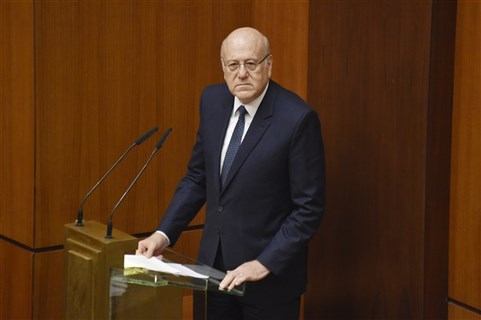
NNA - Caretaker Prime Minister Najib Mikati explained Wednesday to the parliament that the fresh aid package offered to Lebanon by the European Union is unconditioned, and that no agreement has been signed in that respect.

"I confirm that the aid is not conditioned by any prior or subsequent condition, and no agreement has been inked with the European Union regarding it," Mikati told a parliament session devoted to discussing the aid and the displaced Syrians' file.

Mikati stressed the necessity of full accord between the Lebanese to resolve the Syria displacement issue.

"The European aid announced by European Commission President Ursula von der Leyen in the presence of the Cypriot President is a confirmation of the periodic aid the European Commission has been providing to Lebanon for years," Mikati said.

"This European support is devoted to the basic services offered by the Commission to the governmental institutions in the fields of social protection, education, water and healthcare," he explained.

"The President of the European Commission has promised a re-evaluation of this aid every six months in light of Lebanon's need. She also promised doubled amounts and European investments in Lebanon once the required reform laws are approved," he added.

"We insisted that this aid be aimed at encouraging the Syrian displaced to return to their country and not to stay in Lebanon," he said.

"The government has never failed to make the suitable decision regarding the displaced file, and the army and security apparatuses are assuming their duties to curb the unjustified displacement which is threatening the independence of our entity," he underlined.

"What is needed today is a unified national position away from outbidding and accusations," he concluded.

Print


Lebanon PM: My country cannot cope with the Syrian refugee crisis
Tuesday, Jan 21, 2014

The Telegraph – By PM Najib Mikati

As civil war rages on in Syria, Lebanon is being hit by wave after wave of human suffering. Lebanon is going through a critical time. These are not mere alarmist words but the grim reality of my country being left to bear the brunt of the refugee crisis caused by the three-year civil war in Syria. Unless world leaders meeting in Kuwait and Geneva back up their promises of assistance with action, the country risks losing the ability to sustain its humanitarian aid to displaced Syrians.

Lebanon is one of the smallest countries in the region, yet it has shouldered the biggest burden of the humanitarian crisis caused by the bloodiest uprising of the so-called Arab Spring. As we enter into a new year, the UN estimates that on current trends 900,000 conflict refugees will have entered Lebanon – approaching a quarter of the country's pre-crisis population.

If the United Kingdom faced the same humanitarian crisis it would be the equivalent of three times Scotland’s population of 5 million crossing into England and camping out in the Yorkshire dales. In the US it would be equivalent to 100 million refugees. Until now Lebanon has adopted a policy of never closing its borders to Syrian families seeking refuge. But as the uprising enters its fourth year, Lebanon can no longer cope on its own.

As the recent graphic news bulletins have shown, refugees are living in makeshift camps in the Bekaa Valley region in the winter snows – many lacking warm clothing and proper shelter, clean water and sanitation – with the risk now of disease spreading and adding to their plight.

Adding fuel to an already volatile situation in Lebanon, many have sought shelter in the remote borderline areas that are already suffering from poverty and development predicaments. In some sectors, like Wadi Khaled and Ersal, they outnumber the national residents...

Every day hundreds of Syrians are still fleeing the violence which continues with unabated ferocity. No country should be left on its own to cope with such a wave of human suffering.

Since becoming Prime Minister, I have initiated a policy of disassociation from all ongoing Arab-Arab tensions – with the aim of keeping Lebanon out of the conflicts destabilising the region.

The Middle-East is witnessing one of the most tumultuous times in its history: the amount of rapid change and challenge, and of growing dangers and complex threats, is truly unprecedented. Arab societies and political systems are literally involved in a struggle for their continued existence.

Lebanon, given its geographical position, is bound to be affected by these turbulent times. As prime minister, my main concern is Lebanon’s unity and safety and that it be spared from what is happening elsewhere in the region. The adoption of the disassociation policy by all factions here will prevent sectarian tensions and political strife. I will take this opportunity to call on international leaders to perceive Lebanon as the beacon of hope for freedom and pluralism in our region.

Alleviating the humanitarian crisis facing the refugees remains our immediate priority at the Kuwait and Geneva conferences. But there are dangerous signs that the conflict is now spreading beyond Syria’s borders, threatening to destabilise Lebanon and the wider region.

The recent security incidents in Beirut, including outside the Iranian embassy and the assassination of the former Finance Minister Mohamad Chatah, have increased fears of dragging Lebanon back into the abyss of sectarian strife.

The UN must now step up efforts to bring both sides in Syria to the negotiating table to end the bloodshed and achieve a political settlement. All the key players regionally and globally should be there – and time is running out to avert catastrophe that could overwhelm the region.

My central belief is in finding the right workable solution. It is based on the Wasatiya (centrism) doctrine that allows freedom of thought and adopts liberal values of equity, tolerance and pluralism.

This approach can bring hope of a brighter future to a troubled region. But time is running out to avert catastrophe.

In the meantime the plight of the refugees must not be overlooked. At the Kuwait and Geneva II peace conferences the Lebanese Government will outline its Crisis Management Strategy to address the Economic and Social Impact of the Syrian Conflict on Lebanon in the form of a Lebanese, World Bank and UN initiative for a $1.6 billion fund. The fund will help set up required assistance to the displaced and hosting communities and work with global agencies and state ministries to tackle the humanitarian crisis.

Financial aid – while welcome and vital – is not enough. We urgently need support for the 2014 Lebanese response plan including a commitment from the international community to securing safe zones for refugees within Syria itself.

Lebanon cannot take any more displaced people. The huge influx of refugees is threatening the country's economic and social stability, placing huge strains on an already overloaded health system. According to the World Bank overcrowding and lack of water and sanitation systems is bringing risks of epidemics of waterborne diseases, measles and tuberculosis.

Historically Lebanon has been a land of refuge for people fleeing persecution, so my country has a long and troubled history of housing displaced people. We still have the descendants of Palestinians who fled their homes in 1948 after the occupation of Palestine still living in camps across Lebanon. That is why it is vital that “safe” zones are created for the refugees in their own country – Syria – rather than establishing what could become another set of permanent camps in Lebanon for displaced people.

The impact of the Syrian conflict is challenging an already delicate inter-communal balance in Lebanon, with overcrowding, saturation of basic services and competition for jobs increasing social tensions.

Thousands more young unskilled Lebanese are expected to become unemployed, doubling the jobless rate to over 20 per cent while by the end of this year another 170,000 Lebanese will be pushed into poverty, adding to the one million already below the poverty line.

The international community cannot stand aside. It must be proactive and prevent the collapse of a small country that cannot alone carry this colossal weight.

This is not an internal Lebanese crisis, nor should it be treated as if it was a tragedy caused by a natural disaster like an earthquake or a tsunami. It is potentially a universal disaster and a threat to regional stability.

We expect nothing less than the unconditional support of the international community to Lebanon.

The time to act is now.

more videos
حديث الرئيس نجيب ميقاتي إلى قناة الجديد